
Product Description
| Download Documents | |
| Product Sheet | |
| SDS | COA-NB0361041 |
AqT®-Trolox: The Ultimate Water-Soluble Antioxidant
Introducing AqT-Trolox, engineered with CellMosaic’s AqueaTether. This highly purified, completely water-soluble Vitamin E derivative is designed for seamless use in aqueous research. It eliminates the need for organic solvents and simplifies complex assays.
As a potent radical scavenger, AqT-Trolox provides strong protection against oxidative stress. It can be used for cell viability studies, neuroprotection research, and antioxidant capacity measurements (TEAC/ORAC assays).
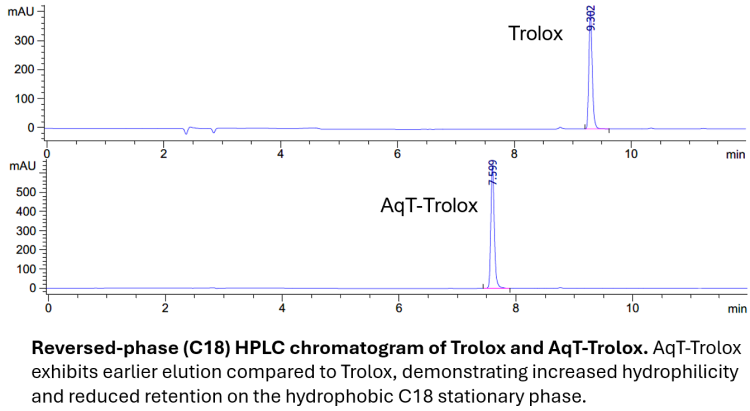
With outstanding solubility (>45 mg/mL in water) and excellent stability, AqT-Trolox enables faster preparation and reliable results. It supports reproducible data in biological systems, from cell culture to in vivo models, without solvent-related toxicity or assay interference.
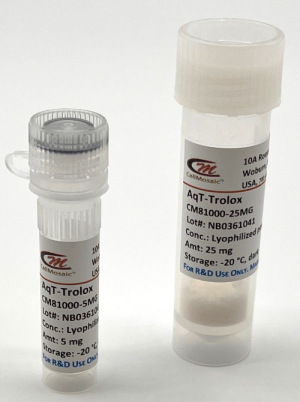
Supplied as lyophilized powder in vials containing 5 mg or 25 mg Trolox Equivalents (TE), as determined by the ABTS assay. For bulk orders, please contact us for a quotation.
Please consult the Certificate of Analysis (COA) for the lot-specific gravimetric amount of AqT-Trolox supplied per vial, which is higher than 5 mg and 25 mg. For Research Use Only. Not for Use in Human or Diagnostic Procedures.
Key-Features
- Truly Water-Soluble: Dissolves instantly in just water or any aqueous buffers (for example PBS, cell media) for direct application. No DMSO or ethanol required to obtain high concentration stock solution.
- Accurate amount (Trolox Equivalent) per vial: AqT-Trolox amount per vial is determined by ABTS+ (2,2′-azinobis-(3-ethylbenzothiazoline-6-sulfonic acid)) radical cation quenching assay.
Usage
To prepare a 1 mM AqT-Trolox solution, dissolve the contents of the 5 mg (TE) vial in 20 mL of water and dissolve the contents of the 25 mg (TE) vial in 100 mL of water. This will yield a final concentration of 1 mM AqT-Trolox (TE) in each solution. Since the phenolic group in Trolox is unstable under basic conditions, it is recommended that the pH of the dissolution buffer be maintained between 3 to 7.5.
AqT-Trolox is for Research Use Only (RUO) and must not be used for human consumption. CellMosaic assumes no responsibility for any use of this product outside of its recommended applications.
Applications
- Antioxidant Capacity Assays
Used as a reference standard in assays such as ABTS, DPPH, ORAC, and FRAP, with results commonly expressed as Trolox Equivalents (TE). - Oxidative Stress Research
Applied to study reactive oxygen species (ROS) scavenging, lipid peroxidation, and redox balance in cell-free and cellular systems. - Cell Culture & In Vitro Studies
Used to reduce oxidative damage in cultured cells, particularly in studies involving mitochondrial dysfunction, hypoxia/reoxygenation, and oxidative injury models. - Biochemistry & Enzyme Protection
Protects oxidation-sensitive enzymes, metabolites, and cofactors during in vitro biochemical assays. - Neuroscience, Aging & Disease Models
Utilized in research related to neurodegeneration, cardiovascular disease, cancer, and aging, where oxidative stress plays a central role. - Food, Nutrition & Cosmetic Research
Serves as a benchmark antioxidant for evaluating the antioxidant capacity of foods, dietary supplements, and cosmetic formulations (research use only).
Storage and Solution Stability
- Recommended storage of the product is below −20 °C as solid in dark.
- A 1 mM stock solution prepared in water (pH 6.1) is stable at −20 °C in dark for at least 24 hours, with no loss of activity as determined by the ABTS assay.
Key References
Antioxidant Capacity Assays (ABTS/TEAC, ORAC, FRAP):
1. Miller NJ, Rice-Evans CA, Davies MJ, Gopinathan V, Milner A. Antioxidant activity applying an improved ABTS radical cation decolorization assay. Free Radic Biol Med. 1999;26(9-10):1231-1237.
Highlight: Landmark paper establishing the widely used ABTS/TEAC assay, using Trolox as the standard for expressing antioxidant capacity as Trolox Equivalents (TE).
2. Benzie IFF, Strain JJ. The ferric reducing ability of plasma (FRAP) as a measure of “antioxidant power”: The FRAP assay. Anal Biochem. 1996;239(1):70-76.
Highlight: Foundational work introducing the FRAP assay, a core antioxidant method frequently calibrated with Trolox standards.
3. Huang D, Ou B, Prior RL. The chemistry behind antioxidant capacity assays. J Agric Food Chem. 2005;53(6):1841-1856.
Highlight: Highly cited review explaining the chemistry and interpretation of antioxidant assays (ABTS, DPPH, ORAC, FRAP), reinforcing Trolox as the most common reference antioxidant.
Oxidative Stress Research & ROS Protection:
4. Aktan F. Oxidative stress-induced apoptosis prevented by Trolox. Life Sci. 1994;55(4):249-254.
Highlight: Demonstrates Trolox protection against oxidative stress–induced apoptosis, supporting its use in ROS scavenging and oxidative injury models.
5. Milatovic D, Dettbarn WD, Gupta RC. Trolox protects against manganese-induced oxidative stress in neuronal cells. Toxicol In Vitro. 2011;25(1):200-206.
Highlight: Shows Trolox reduces oxidative damage in neuronal cell models, supporting its relevance in neurotoxicity and oxidative stress research.
Cell Culture & In Vitro Oxidative Injury Models:
6. Santos MM, et al. Trolox and ascorbic acid reduce oxidative stress in small intestinal epithelial cells. PLoS One. 2015;10(5):e0127810.
Highlight: Confirms Trolox efficacy in reducing oxidative stress markers in cultured epithelial cells, supporting use in cell-based antioxidant protection studies.
7. Lionetto MG, et al. Concentration dependence of the antioxidant and prooxidant activity of Trolox in HeLa cells: involvement in apoptotic volume decrease. Antioxidants (Basel). 2020;9(11):1058.
Highlight: Important study showing Trolox effects are dose-dependent, including both antioxidant and potential prooxidant activity at certain conditions.
Food, Nutrition, and Natural Product Benchmarking (RUO):
8. Re R, Pellegrini N, Proteggente A, Pannala A, Yang M, Rice-Evans C. Antioxidant activity applying an improved ABTS radical cation decolorization assay. Free Radic Biol Med. 1999;26(9-10):1231-1237.
Highlight: Widely cited reference supporting Trolox-based antioxidant capacity reporting in food chemistry and plant extract studies (Trolox Equivalents standardization).
Other Details
The information in this document is subject to change without notice. CellMosaic® assumes no responsibility for any errors or omissions that may appear in this document. Under no circumstances shall CellMosaic be liable, whether in contract, tort, warranty, or under any statute or on other legal theory, for special, incidental, indirect, punitive, multiple, or consequential damages related to or arising from this document, including but not limited to the use of this product thereof.CellMosaic’s products, including but not limited to AqT®, NeIon™, oxLink™ and sxLink™ (collectively, the “Products”), are covered by, or are the subject of, one or more issued patents and pending patent applications, including without limitation: 9,688,663 B2; 8,907,079 B2; 9,511,150 B2; 9,907,854 B2; 9,346,833 B2; 9,518,067 B2; CN104066451B; CN107043339B; CA 2,841,313; EP 2734238 B1; AU2012284055; JP 6240599 B2; and corresponding foreign patents and patent applications. The purchase of the Product conveys solely a limited, non-exclusive, non-transferable, non-sublicensable license to use the Product only for the purchaser’s internal research and development purposes. No right or license is granted, either expressly or by implication, estoppel, or otherwise, under any patent, trademark, copyright, or other intellectual property right of CellMosaic, except as expressly stated herein. Any commercial use of the Product is strictly prohibited without a separate written agreement from CellMosaic. Prohibited commercial uses include, without limitation: (a) the sale, lease, licensing, distribution, or other transfer of the Product or any materials derived from or produced using the Product; (b) the sale, lease, licensing, or other grant of rights to use the Product or any materials derived from or produced using the Product; and (c) the use of the Product to perform services for a fee or other consideration for third parties, including without limitation contract research, screening services, or diagnostic or therapeutic applications. For information regarding commercial licensing or collaboration, please contact us at info@cellmosaic.com.