
Introducing Functional Groups
Examples of biopolymer modifications used to introduce functional groups for labeling and conjugation are shown below.
Aldehyde Introduction through Amine Groups
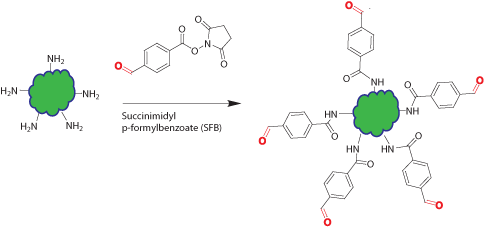
Native proteins, oligonucleotides, and peptides generally do not contain aldehyde functional groups. Introducing aldehyde groups into these biopolymers allows them to react specifically at the aldehyde sites through reductive amination, oxime formation, or hydrazone formation.
This modification introduces aldehyde groups through surface amines, including lysine residues and the N-terminal amine of peptides and proteins, or through amine-modified oligonucleotides. The amine-reactive reagent used is succinimidyl p-formylbenzoate (SFB). Multiple aldehyde groups are usually introduced into the biopolymer, depending on the number of available surface amines and the extent of the reaction.
References:
- Kraehenbuhl, J. P.; Galardy, R. E.; Jamieson, J. D. Preparation and characterization of an immuno-electron microscope tracer consisting of a heme-octapeptide coupled to Fab. J. Exp. Med. 1974, 139(1), 208–223. PMID: 4357686.
- Galardy, R. E.; Stafford, S. S.; Schaefer, M. L.; Ho, H.; La Vorgna, K. A.; Jamieson, J. D. Biologically active derivatives of angiotensin for labeling cellular receptors. J. Med. Chem. 1978, 21(12), 1279–1283. PMID: 214560.
Aldehyde Introduction through Diol Groups
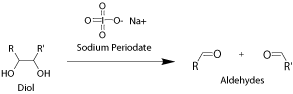
Some native proteins and antibodies contain carbohydrate modifications. Aldehyde groups can be introduced into these carbohydrates through periodate oxidation. One or a few aldehyde groups are typically introduced into the biopolymer, depending on the nature of the biopolymer and the extent of oxidation. This method allows site-specific modification and conjugation.
References:
- Bobbitt, J. M. Periodate oxidation of carbohydrates. Adv. Carbohydr. Chem. 1956, 11, 1–41. PMID: 13469627.
- Rothfus, J. A.; Smith, E. L. Glycopeptides. IV. The periodate oxidation of glycopeptides from human gamma-globulin. J. Biol. Chem. 1963, 238(4), 1402–1410. PMID: 13975369.
- Lotan, R.; Debray, H.; Cacan, M.; Cacan, R.; Sharon, N. Labeling of soybean agglutinin by oxidation with sodium periodate followed by reduction with sodium [3-H]borohydride. J. Biol. Chem. 1975, 250(5), 1955–1957. PMID: 163260.
- Van Lenten, L.; Ashwell, G. Studies on the chemical and enzymatic modification of glycoproteins. A general method for the tritiation of sialic acid-containing glycoproteins. J. Biol. Chem. 1971, 246(6), 1889–1894. PMID: 4323238.
- Wilchek, M.; Bayer, E. A. Labeling glycoconjugates with hydrazide reagents. Methods Enzymol. 1987, 138, 429–442. PMID: 3110546.
Thiol Introduction Using Traut's Reagent
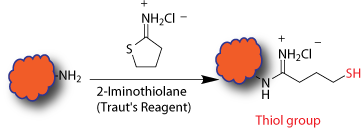
This is an intermediate step that introduces one or more thiol groups into a biopolymer and prepares it for conjugation through sulfhydryl groups. The modification is generally performed immediately before conjugation or labeling. However, the modified biopolymer may be stored in the presence of reducing agents.
The basic chemistry involves reacting amines with 2-iminothiolane, also known as Traut's reagent, to generate sulfhydryl groups on the biopolymer. Multiple sulfhydryl groups may be introduced, depending on the number of available amine groups and the extent of the reaction.
References:
- Traut, R. R.; Bollen, A.; Sun, T. T.; Hershey, J. W.; Sundberg, J.; Pierce, L. R. Methyl 4-mercaptobutyrimidate as a cleavable cross-linking reagent and its application to the Escherichia coli 30S ribosome. Biochemistry. 1973, 12(17), 3266–3273. PMID: 4581787.
- Jue, R.; Lambert, J. M.; Pierce, L. R.; Traut, R. R. Addition of sulfhydryl groups to Escherichia coli ribosomes by protein modification with 2-iminothiolane (methyl 4-mercaptobutyrimidate). Biochemistry. 1978, 17(25), 5399–5406. PMID: 365229.
- Lambert, J. M.; Jue, R.; Traut, R. R. Disulfide cross-linking of Escherichia coli ribosomal proteins with 2-iminothiolane (methyl 4-mercaptobutyrimidate): evidence that the cross-linked protein pairs are formed in the intact ribosomal subunit. Biochemistry. 1978, 17(25), 5406–5416. PMID: 365230.
Thiol Introduction Using SATA
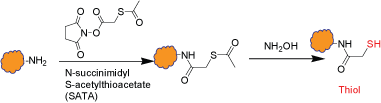
This is an intermediate step that introduces one or more thiol groups into a biopolymer through the reaction of amines with N-succinimidyl S-acetylthioacetate (SATA). The modified biopolymer contains protected sulfhydryl groups and can be stored. An additional step is required to remove the thiol-protecting groups immediately before labeling or conjugation.
Multiple sulfhydryl groups may be introduced, depending on the number of available amine groups and the extent of the reaction. Removal of the thiol-protecting groups does not require disulfide-reducing reagents.
References:
- Duncan, R. J.; Weston, P. D.; Wrigglesworth, R. A new reagent that may be used to introduce sulfhydryl groups into proteins and its use in the preparation of conjugates for immunoassay. Anal. Biochem. 1983, 132(1), 68–73. PMID: 6353995.
- Derksen, J. T. P.; Scherphof, G. L. An improved method for the covalent coupling of proteins to liposomes. Biochim. Biophys. Acta Biomembr. 1985, 814(1), 151–155.
Disulfide Bond Reduction
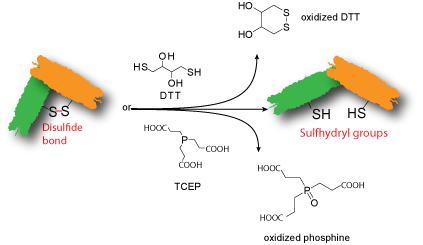
Some biopolymers contain disulfide bonds. If these bonds are not essential for the biopolymer's activity or structural integrity, they can be cleaved to generate free sulfhydryl groups for further modification. Common reducing agents include Cleland's reagent, dithiothreitol (DTT), and tris(2-carboxyethyl)phosphine (TCEP).
One or a few sulfhydryl groups may be generated, depending on the number of disulfide bonds in the biopolymer and the extent of the reduction. Because the modified biopolymer contains free sulfhydryl groups with a limited storage life, it should generally be used immediately in the subsequent reaction.
References:
- Cleland, W. W. Dithiothreitol, a new protective reagent for SH groups. Biochemistry. 1964, 3, 480–482. PMID: 14192894.
- Burns, J. A.; Butler, J. C.; Moran, J.; Whitesides, G. M. Selective reduction of disulfides by tris(2-carboxyethyl)phosphine. J. Org. Chem. 1991, 56, 2648–2650.