Advanced Conjugation Processes and PerKit®
CellMosaic’s Advanced Conjugation Processes are the foundation of our custom bioconjugation services and PerKit® product line. Since 2008, these technologies have been continuously optimized through hundreds of customer projects involving antibodies, proteins, peptides, oligonucleotides, enzymes, and other biomolecules. As of February 2026, CellMosaic has completed more than 700 custom projects and developed more than 500 unique custom conjugates covering a broad range of compounds.
Unlike medicinal chemistry, bioconjugation is a complex process that has not yet been fully integrated into conventional drug-development workflows. Traditional medicinal chemistry approaches, including reaction optimization, characterization, purification, and analysis, do not always translate directly to bioconjugation. In a typical small-molecule chemical reaction, yields may be high, products relatively simple, and reactions reproducible. In biopolymer conjugation, however, yields are often lower and products more complex, frequently containing multiple isoforms or polyconjugated species. A reaction condition that works well for one biopolymer may not perform similarly with another closely related biopolymer.
CellMosaic has established an integrated platform consisting of conjugation chemistry, purification, analytical characterization, and process optimization that can be readily adapted to a wide variety of biomolecules.
- Bioconjugation workflow
- Labeling and bioconjugation methods
- Bioanalytical, biopurification, and bioassay methods
- Modification of biopolymers and small molecules
Bioconjugation Workflow
CellMosaic has developed an integrated bioconjugation workflow that can be readily adapted to a wide range of biopolymers. This workflow incorporates multiple linkers and conjugation chemistries, enabling the synthesis of stable or releasable conjugates. Purification and analytical methods have also been established for a broad variety of molecules, including antibodies, proteins, peptides, oligonucleotides, and enzymes. With appropriate adjustments, many conjugates can be developed using this integrated model and CellMosaic’s established methods and facilities.
Labeling and Bioconjugation Methods
CellMosaic employs several strategies to obtain single-labeled or site-specific bioconjugates, including site-directed cysteine mutagenesis, structural characterization, selective labeling chemistry, and specialized purification techniques. These strategies help improve conjugate quality, homogeneity, and reproducibility.
Peptide Labeling and Conjugation
Peptide–drug conjugates and biopolymer–peptide conjugates are prepared using proprietary bioconjugation strategies developed at CellMosaic. Drugs or biopolymers can be conjugated at selected positions on a peptide, including the N-terminus, C-terminus, or an internal site. These methods are designed to produce a single, highly purified bioconjugate.
Key advantages of this peptide-conjugation strategy include:
- Flexibility to attach a drug or molecule of interest at a selected position on the peptide.
- Preservation of other functional groups, such as OH, NH2, and SH, during conjugation.
- Adaptability to a wide range of compounds and conjugation requirements.
- A relatively short development timeline for establishing the conjugation strategy.
Antibody and Antibody Fragment Conjugation
CellMosaic has developed specialized bioconjugation strategies for site-specific antibody labeling and conjugation. Small-molecule drugs, toxins, and other payloads can be conjugated to selected antibody sites away from the antigen-binding region. CellMosaic has also developed methods for introducing a single labeling site into an antibody and offers processes for preparing antibody fragments for subsequent bioconjugation.
Oligonucleotide-Based Bioconjugation
Major challenges in developing oligonucleotide analogs and siRNA-based therapeutics include limited cellular uptake, poor in vivo pharmacokinetics, and insufficient tissue or cell-targeting specificity. Chemical conjugation of oligonucleotides or siRNAs with bioactive molecules, lipids, polymers, or targeting ligands can help address these limitations. Oligonucleotides can also be designed to selectively target genes or deliver small-molecule drugs to disease-associated sites.
CellMosaic’s oligonucleotide-conjugation strategies allow drugs or biopolymers to be attached at the 3′ end, 5′ end, or through a modified base. Conjugation may be performed during solid-phase synthesis or through post-synthesis solution-phase chemistry, typically producing a single, highly purified conjugate.
Key advantages of this strategy include:
- Flexibility to attach a drug or molecule of interest at a selected position on the oligonucleotide.
- Preservation of functional groups such as OH, NH2, and SH during conjugation.
- Adaptability to different compounds and conjugation chemistries.
- A relatively short development timeline for establishing the conjugation strategy.
Protein-Based Bioconjugation
Recombinant proteins may exhibit limited in vivo stability, sometimes requiring high doses for therapeutic use. Chemical modification with water-soluble molecules can improve protein stability and may enhance therapeutic performance. Recombinant proteins can also be conjugated to antibodies, drugs, toxins, or other biomolecules to achieve additional functional benefits.
Traditional protein-labeling methods often target multiple lysine residues. This approach can alter the overall isoelectric point of the protein and may generate partially active, inactive, or heterogeneous conjugates with variable physicochemical properties. To address these challenges, CellMosaic combines mutagenesis, purification, and selective labeling technologies to produce high-quality protein conjugates.
Bioanalytical, Biopurification, and Bioassay Methods
The CellMosaic team has extensive experience analyzing and purifying small organic compounds, biopolymers, and bioconjugates using HPLC with a range of stationary phases and separation modes, including reversed-phase, size-exclusion, hydrophobic interaction, anion-exchange, and cation-exchange chromatography.
CellMosaic has established methods for analyzing peptides, oligonucleotides, proteins, antibodies, and their conjugates. A key area of expertise is the development of purification methods capable of isolating a single, highly purified bioconjugate based on its specific physicochemical properties. For example, many peptide- and oligonucleotide-based conjugates are purified by reversed-phase HPLC, while antibody-based conjugates may be purified using affinity methods. Other biomacromolecule-based conjugates, such as horseradish peroxidase conjugates, may be purified by size-exclusion chromatography.
CellMosaic has also developed mass spectrometry methods using electrospray ionization mass spectrometry (ESI-MS) and matrix-assisted laser desorption/ionization time-of-flight mass spectrometry (MALDI-TOF MS) for the characterization of various bioconjugates.
An essential component of bioconjugation is understanding the characteristics of the starting biopolymers and quantifying their reactive functional groups. CellMosaic has established methods for quantifying thiol, maleimide, and amine groups during conjugation, helping to achieve predictable final loading and maintain batch-to-batch consistency.
Modification of Biopolymers and Small Molecules
Certain biological applications require the introduction of functional groups or linkers into a biopolymer. CellMosaic has developed multiple methods for modifying biopolymers with functional groups used for labeling or conjugation, including aldehyde and thiol groups.
The introduction of aldehyde groups enables selective reactions such as reductive amination, oxime formation, and hydrazone formation. CellMosaic also has expertise in preparing antibody fragments, including Fab, Fab′, and combined antibody-fragment formats, as well as bispecific antibody constructs, using chemical and enzymatic methods.
PerKit® Products
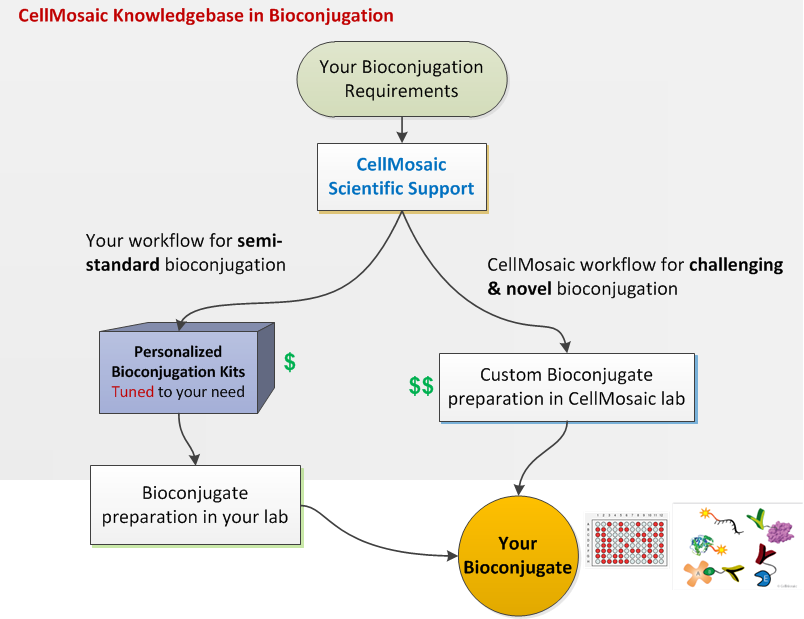
PerKit® (Personalized Bioconjugation Kit) is CellMosaic’s comprehensive line of bioconjugation kits. Introduced in 2016 and continually refined, the product line is based on CellMosaic’s proprietary Advanced Conjugation Processes.
Many commercially available bioconjugation kits contain only one or two reagents intended for generic biochemical labeling. For example, a fluorescent dye-labeling kit may contain only a reactive fluorescent dye without application-specific examples, analytical data, purification components, cleanup accessories, or a detailed user manual. These limitations can result in failed or suboptimal downstream experiments.
PerKit® products are designed to provide a more complete solution for the bioconjugation of different biomolecules. The product line is particularly useful for customers with limited development budgets or those performing frequent or larger-scale conjugations of one or more molecules.
Key Advantages of PerKit®
- Tailored Solutions: Each molecule is unique, and a bioconjugation process that works for one molecule may not work equally well for another. PerKit® products are designed for specific classes of molecules to help customers perform bioconjugation with greater confidence. Certain PerKit® products are made to order, with kit contents and user manuals adapted based on customer-provided information.
- Validated Processes: Most linkers, spacers, and conjugation chemistries used in PerKit® products have been validated with related conjugates developed through CellMosaic’s Custom Bioconjugation Services. PerKit® products are tested before market release, and representative conjugation data are provided when available.
- High-Quality Conjugates: Purification and cleanup accessories are included, where appropriate, to help improve the quality of the final conjugate.
- Ease of Use: Kits include the required reagents and procedures, except for customer-supplied molecules. Most conjugations can be completed within one day.
- Technical Support: Dedicated technical support is available throughout the conjugation process. Additional analytical and characterization services are also available for customers requiring further evaluation of their conjugates.
- Continuous Product Improvement: CellMosaic continually monitors product performance in customers’ hands and updates kit composition or user manuals as needed. Newly developed processes that improve kit performance may also be incorporated into existing PerKit® products.
Since its introduction, the PerKit® product line has expanded steadily. As of August 2024, CellMosaic offered approximately 40 PerKit® products.
Selected PerKit® Product Launches
| Launch Date | PerKit® Product | Primary Application |
|---|---|---|
| December 2016 | HRP–Oligonucleotide Conjugation Kit | Preparation of single-label conjugates for diagnostic applications |
| December 2017 | Antibody–MMAE Conjugation Kit | Antibody–drug conjugate candidate screening |
| July 2019 | AP–Oligonucleotide Conjugation Kit | Preparation of single-label conjugates for diagnostic applications |
| January 2021 | Antibody–Oligonucleotide Conjugation Kit | Drug-candidate screening and antibody–oligonucleotide conjugation |
View the complete PerKit® product portfolio. Projects beyond the scope of a standard PerKit® configuration can be handled through CellMosaic’s Custom Bioconjugation Service.