
Biopolymer Labeling
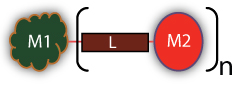
CellMosaic labels biopolymers using both commercially available and custom-synthesized small molecules to produce a wide variety of research, diagnostic, and therapeutic bioconjugates.
Typical small molecules (M2) used for biopolymer labeling include fluorescent dyes, chemiluminescent compounds, biotin, haptens, drugs, and other custom or commercially available molecules containing reactive functional groups such as carboxyl, primary amine, aldehyde, ketone, hydroxyl, hydrazine, aminooxy, or thiol groups.
Typical biopolymers (M1) include antibodies, antibody fragments, enzymes (such as alkaline phosphatase (AP) and horseradish peroxidase (HRP)), proteins, peptides, peptidomimetics, DNA, nucleic acid analogs, and avidin or streptavidin.
In the schematic, L represents the linker connecting the biopolymer (M1) to the small molecule (M2), while n denotes the average degree of labeling (DOL), expressed as the molar ratio of M2 attached to each molecule of M1.