
oxLink™ and sxLink™ Photocrosslinking Technologies
| Technique Note TN202101 |
| oxLink™ & sxLink™ Products |
Dynamic biomolecular interactions are responsible for numerous cellular processes. Heterobifunctional photo-crosslinking reagents have long been valuable tools for studying these interactions.
These reagents are typically small organic compounds containing one functional group for attachment to a biomolecule of interest and a second photoactivatable group for covalently crosslinking nearby interacting partners. CellMosaic has developed two proprietary classes of photo-crosslinking reagents: oxLink™ and sxLink™ reagents (Figure 1). These reagents combine a highly efficient, carbene-generating phenyldiazirine group with reversible chemical conjugation and a superhydrophilic AqT® linker.
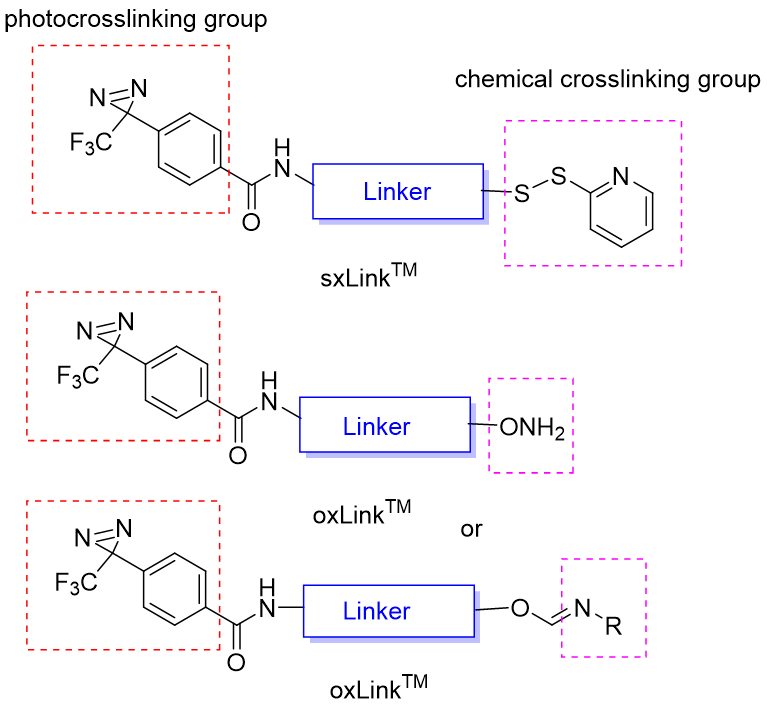
Figure 1. General chemical structures of oxLink™ and sxLink™ reagents. A typical reagent contains: (i) a phenyldiazirine photo-crosslinking group that reacts with a nearby biomolecular partner following photoactivation; (ii) a thiol- or aminooxy-based chemical conjugation group capable of forming a reversible linkage, or a preformed releasable linkage such as a disulfide bond or oxime; and (iii) a flexible linker connecting the two functional groups. The releasable linkage can facilitate downstream purification, enrichment of crosslinked products, and identification of crosslinking sites using advanced mass spectrometric analysis.
Key Functional Modules of oxLink™ and sxLink™
1. Photo-Crosslinking Module
The properties of a photo-crosslinking reagent are critical for obtaining reliable crosslinking data. First, the reagent must remain stable under the experimental conditions. Second, the photoactivatable group must possess suitable photolysis characteristics. Specifically, the irradiation conditions should not interfere with or alter the function of the biomolecules being studied. Third, the photogenerated reactive intermediate should be highly reactive and should not rearrange into less reactive intermediates.
CellMosaic’s oxLink™ and sxLink™ reagents use the highly efficient carbene-generating 3-trifluoromethyl-3-phenyldiazirine group as the photo-crosslinking module. 3-Trifluoromethyl-3-aryldiazirines undergo photolysis at a relatively long UV wavelength of approximately 360 nm, helping to minimize photodamage to biomolecules. The generated carbene can insert rapidly into C–H bonds. In addition, the electron-withdrawing trifluoromethyl group stabilizes the intermediate diazo isomer and helps limit the formation of side products under typical labeling conditions.
2. Chemical Conjugation Module
sxLink™ Reagents
CellMosaic’s sxLink™ reagents contain a sulfhydryl-reactive pyridyl disulfide group, enabling attachment to specific cysteine residues or free thiol groups on a biomolecule. If the target biomolecule does not contain an accessible free thiol, an sxLink™ reagent may also be prepared with a preformed disulfide linkage connected to another reactive group, such as a carboxylic acid derivative, to enable labeling of native biomolecules.
oxLink™ Reagents
oxLink™ reagents contain an aminooxy group for selective conjugation to biomolecules containing aldehyde or ketone groups. An oxLink™ reagent may also be synthesized with a preformed oxime linkage connected to another reactive group, such as a carboxylic acid derivative, for labeling native biomolecules.
Aminooxy–carbonyl ligation is orthogonal to many common peptide and protein chemistries and can enable highly selective, solid-phase purification of aminooxy-labeled crosslinked products. This purification strategy can be particularly useful for characterizing protein complexes in complex matrices such as plasma, cellular membranes, and cell lysates, where free thiols may interfere with thiol-based labeling and purification.
3. AqT® Linker Module
oxLink™ and sxLink™ reagents are available with ethylene, ethylene glycol, or superhydrophilic AqT® linkers.
The 3-trifluoromethyl-3-phenyldiazirine group is highly hydrophobic. Biomolecules labeled with phenyldiazirine compounds through conventional ethylene- or ethylene glycol-based linkers may therefore exhibit increased aggregation or reduced stability. Incorporation of an AqT® linker can significantly increase water solubility, improve biocompatibility, and reduce nonspecific hydrophobic interactions with other biomolecules.
Applications and Workflows for oxLink™ and sxLink™
Figures 2 and 3 illustrate representative workflows for using reversible disulfide or oxime linkages to capture interacting biomolecular partners, identify crosslinking sites, or detect interaction partners.
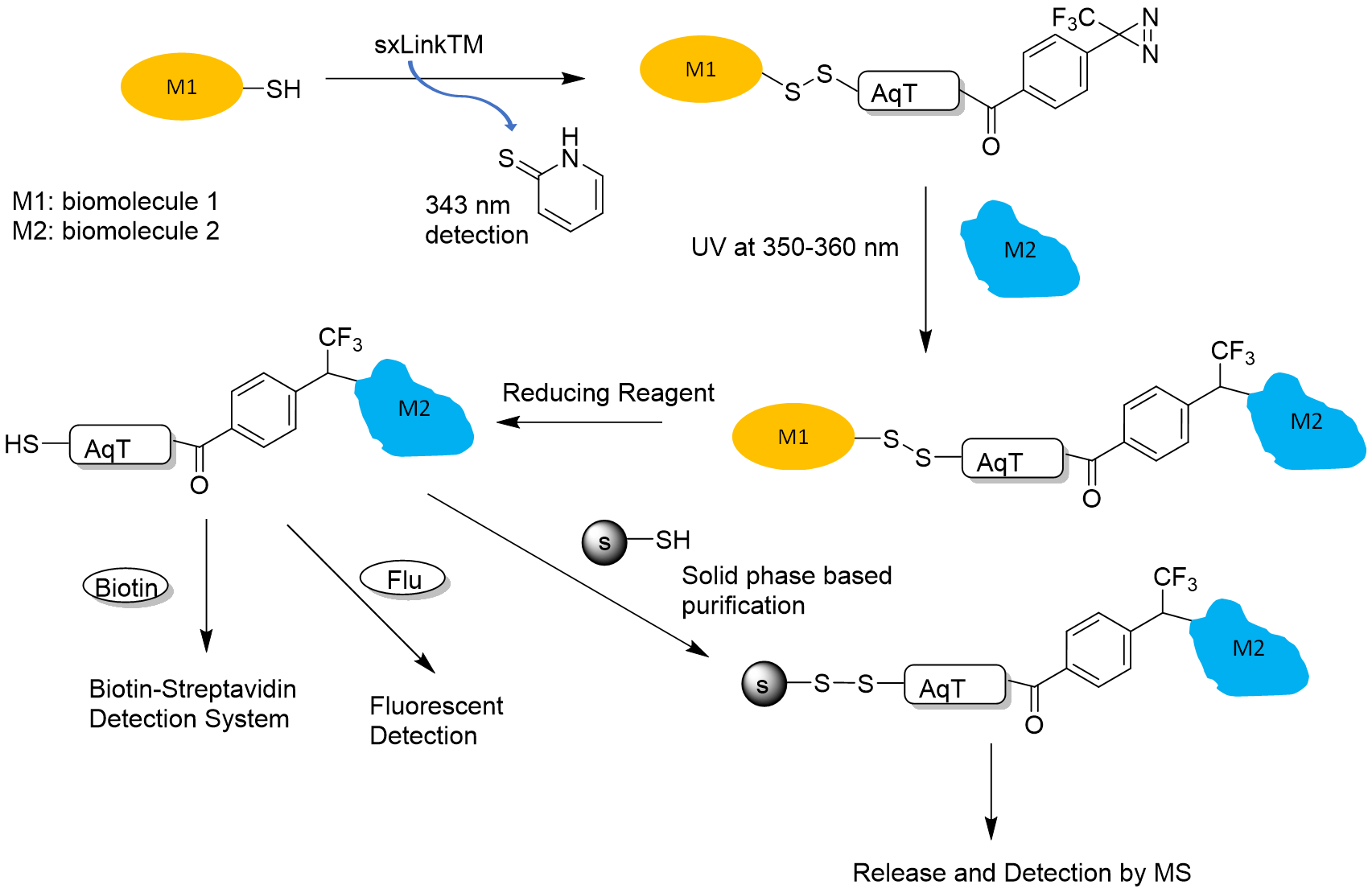
Figure 2. sxLink™ workflow using the water-soluble phenyldiazirine reagent sxLink™ T2A14. First, sxLink™ is attached to a target biomolecule of interest, M1, through thiol–disulfide exchange. Labeling progress can be monitored by UV analysis of the released chromophore, 2-thiopyridone, at 343 nm. The modified biomolecule M1 is then reconstituted into its native complex with biomolecule M2. UV irradiation activates the phenyldiazirine group, resulting in covalent crosslinking to the neighboring biomolecule M2. Finally, reduction of the disulfide bond releases M1 and transfers a free thiol-containing tag to M2, enabling detection or further analysis of the interacting partner.
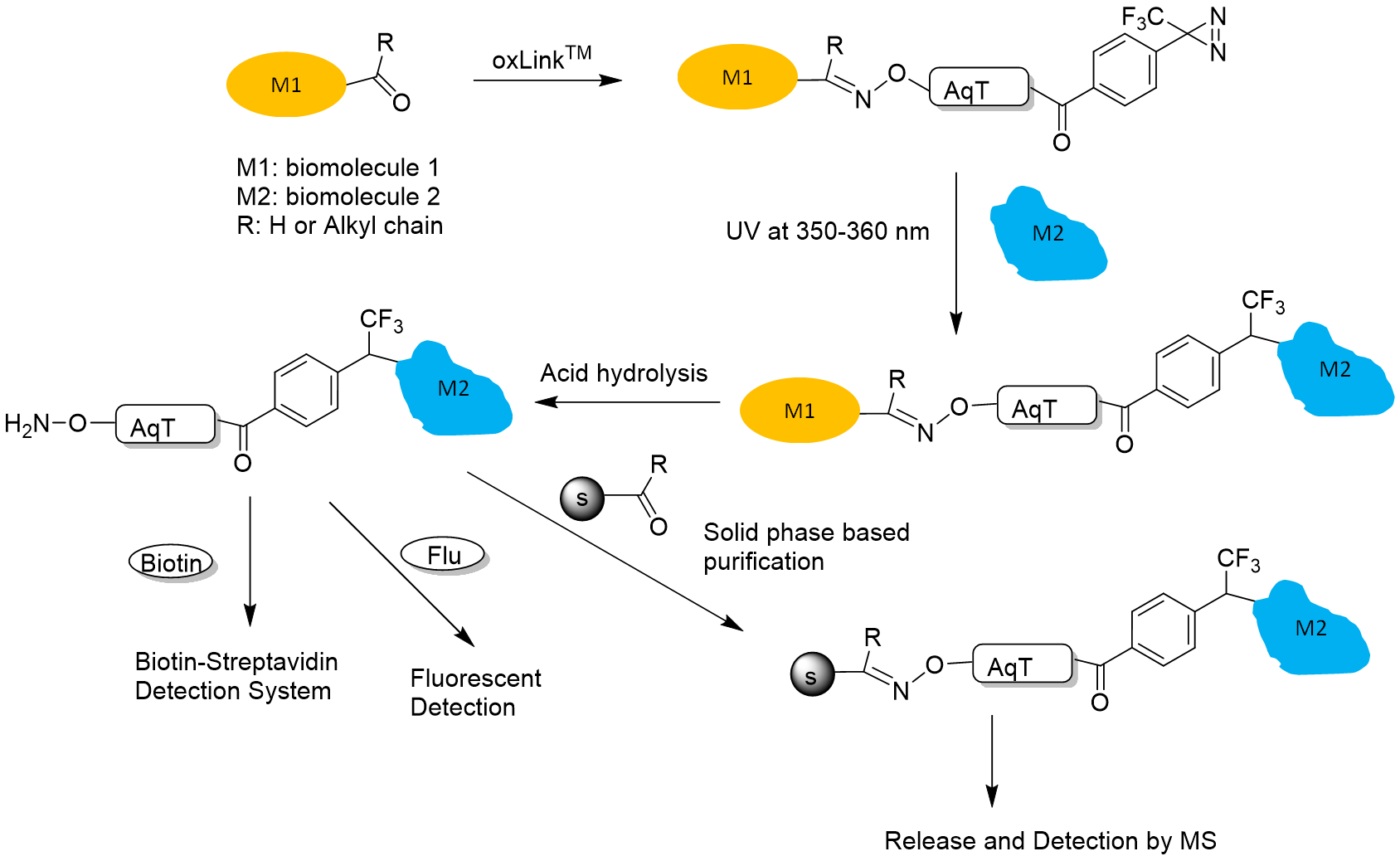
Figure 3. oxLink™ workflow using the water-soluble phenyldiazirine reagent oxLink™ T2A10. First, oxLink™ is attached through its aminooxy functional group to a target biomolecule of interest, M1, containing an introduced aldehyde or ketone group. After photo-crosslinking to the neighboring biomolecule M2, the oxime linkage can be hydrolyzed to release M1 and generate a free aminooxy group on M2. The transferred aminooxy group can subsequently react with an aldehyde- or ketone-containing solid support, biotin reagent, fluorescent dye, or other detection reagent for purification, enrichment, detection, or identification.
Patent and Licensing Information
Patent Protection
oxLink™ and sxLink™ crosslinking reagents are covered by U.S. Patent Nos. 8,907,079 and 9,511,150, U.S. Patent Application No. 14/965,699, and corresponding patents or patent applications in other countries owned by CellMosaic, Inc.
Research-Use License
The purchase of oxLink™ or sxLink™ products includes a limited license for internal research and development use only. The purchase does not grant rights for commercial use.
Commercial-Use Restrictions
Commercial use includes, but is not limited to:
- The sale, lease, license, or other transfer of the material or any material derived from or produced using it.
- The sale, lease, license, or other grant of rights to use the material or any material derived from or produced using it.
- The use of the material to perform services for a fee on behalf of third parties, including contract research, drug screening, or related commercial services.
Commercial Licensing
Organizations interested in using oxLink™ or sxLink™ reagents for commercial purposes should contact CellMosaic for licensing information.
References
- Protein crosslinking reviews:
- Brunner, J. (1993). Annu. Rev. Biochem. 62, 485–514.
- Freedman, R. B. (1979). Trends Biochem. Sci., 193–197.
- Herrmann, J. M., Westermann, B., and Neupert, W. (2001). Methods Cell Biol. 65, 217–230.
- Fancy, D. A. (2000). Curr. Opin. Chem. Biol. 4, 28–32.
- Fasold, H., Klappenberger, J., Meyer, C., and Remold, H. (1971). Angew. Chem. Int. Ed. 10, 795–801.
- Bayley, H. (1983). Photogenerated Reagents in Biochemistry and Molecular Biology, Vol. 12. Elsevier, Amsterdam, The Netherlands.
- Gritsan, N. P., Gudmundsdóttir, A. D., Tigelaar, D., Zhu, Z., Karney, W. L., Hadad, C. M., and Platz, M. S. (2001). J. Am. Chem. Soc. 123, 1951–1962.
-
- Smith, R. A. G., and Knowles, J. R. (1973). J. Am. Chem. Soc. 95, 5072–5073.
- Smith, R. A. G., and Knowles, J. R. (1975). J. Chem. Soc., Perkin Trans. 2, 686–694.
- Brunner, J., Senn, H., and Richards, F. M. (1980). J. Biol. Chem. 255, 3313–3318.
-
- Nassal, M. (1983). Liebigs Ann. Chem., 1510–1523.
- Nassal, M. (1984). J. Am. Chem. Soc. 106, 7540–7545.
- Marriott, G., and Ottl, J. (1998). Methods Enzymol. 433, 155–175.
- Reversible thiol linkage for studying rhodopsin and transducin interactions:
- Resek, J. F., Bhattacharya, S., and Khorana, H. G. (1993). J. Org. Chem. 58, 7598–7601.
- Resek, J. F., Farrens, D., and Khorana, H. G. (1994). Proc. Natl. Acad. Sci. USA 91, 7643–7647.
- Cai, K., Itoh, Y., and Khorana, H. G. (2001). Proc. Natl. Acad. Sci. USA 98, 4877–4882.
- Huang, Y., and Khorana, H. G. (2003). Mapping of Contact Sites in the Interaction Between Transducin and Light-Activated Rhodopsin. Presented at the 17th Symposium of the Protein Society, July 26–30, Boston, Massachusetts.
- Rose, K., Zeng, W., Regamey, P., Chernushevich, I. V., Standing, K. G., and Gaertner, H. F. (1996). Natural peptides as building blocks for the synthesis of large protein-like molecules with hydrazone and oxime linkages. Bioconjugate Chem. 7, 552–556.