
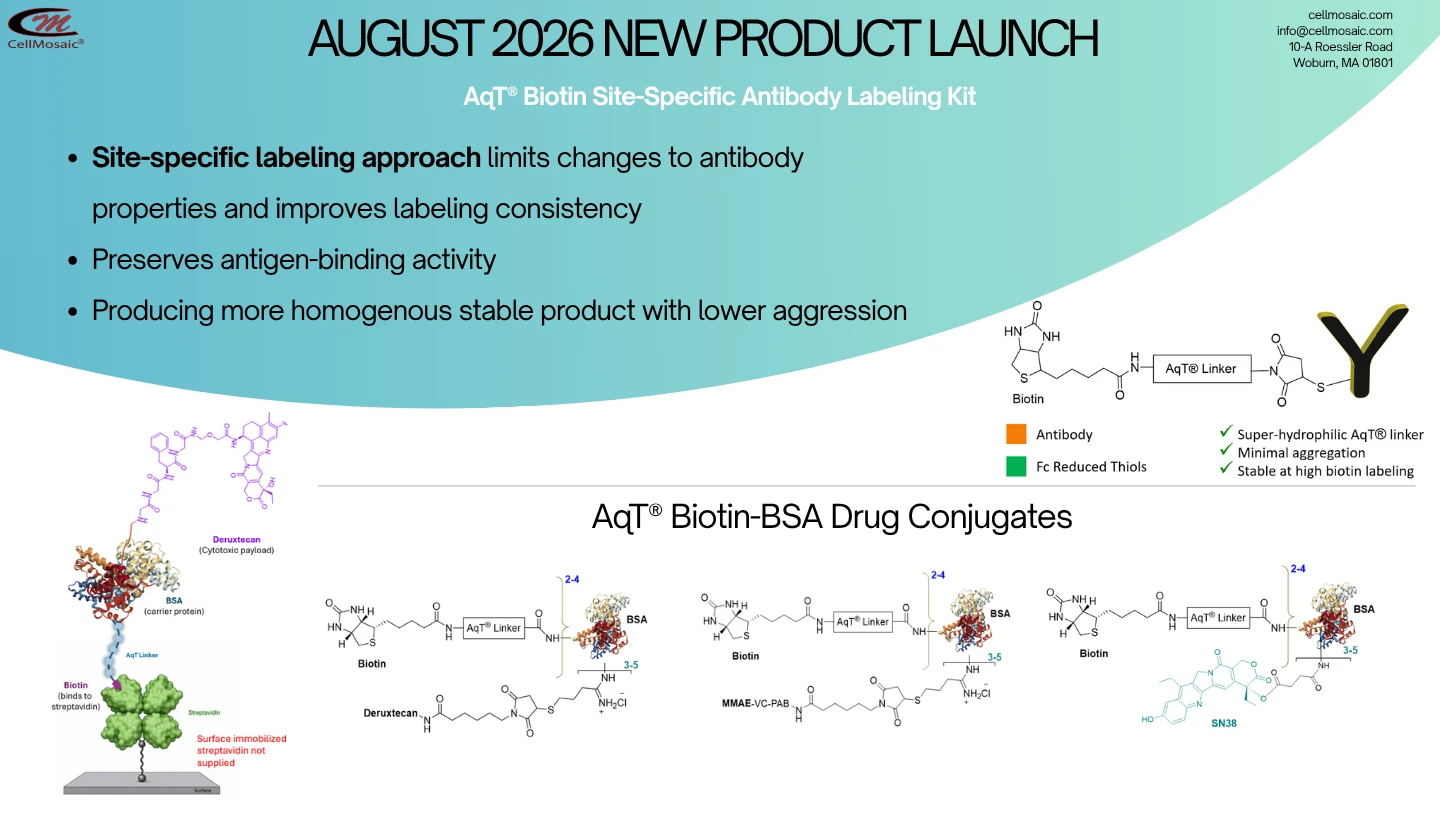
Building on our site-specific antibody-drug conjugation (ADC) technologies, CellMosaic® is launching an AqueaTether®-enabled antibody biotinylation kit in August 2026. Unlike conventional random surface-amine labeling, the kit targets reduced disulfide bonds in the Fc region.
AqT® technology helps preserve antigen-binding activity while producing more homogeneous, stable biotinylated antibodies with lower aggregation. This site-specific approach also limits changes to antibody properties and improves labeling consistency.
CM86141 – AqT® Biotin Site-Specific Antibody Labeling Kit: available for 0.1 mg, 0.1–1 mg, and 1–3 mg antibody labeling scales.
Applications and Advantages of Site-Specific AqT® Biotinylated Antibodies
These antibodies are suitable for ELISA, flow cytometry, IHC, ICC, Western blotting, immunoprecipitation and pull-down assays, biosensors, surface immobilization, cell isolation, and magnetic separation. Fc-region labeling helps preserve antigen-binding affinity and supports proper orientation on streptavidin-coated surfaces. AqT® biotinylation can also reduce nonspecific interactions, improve stability, and enhance sensitivity in streptavidin-based detection systems.
Example reagent made using this labeling technology and representative data
CM86169 – AqT® Biotin Reduced Thiol-Labeled Trastuzumab (anti-HER2 mAb): for HER2 detection, competition and pull-down assays, selection and capture of HER2-positive cells, internalization studies, and targeted imaging.
Related trastuzumab reagents released at the same time:
CM51002 – Trastuzumab HPLC Standard, hIgG1κ mAb
CM51001 – Trastuzumab Anti-HER2 mAb Control
AqT® Biotin-BSA Drug Conjugates
Drug–BSA conjugates present small-molecule drugs on assay surfaces for bead-based assays, ELISA, SPR, and BLI. Conventional conjugates often rely on passive adsorption to plastic, glass, or beads, which can produce variable orientation and surface density. Adding biotin enables specific immobilization on streptavidin-coated surfaces and helps keep drug moieties accessible for target binding.
Beyond assays, biotinylated drug–BSA conjugates can support modular targeting studies. When paired with a compatible targeting construct, the targeting component can be changed without resynthesizing the drug conjugate. The platform may also be used to study albumin-mediated tumor accumulation, payload release, and biodistribution.
Dual labeling is challenging because payloads such as deruxtecan (Mc-GGFG-DXd) are highly hydrophobic. Loading multiple hydrophobic molecules onto BSA can reduce solubility and promote aggregation; biotin may compound these effects. Commercial dual-labeled drug–biotin–BSA conjugates are therefore uncommon.
CellMosaic’s proprietary AqT® super-hydrophilic linkers improve aqueous solubility and help minimize aggregation. The AqT® Biotin-BSA-Drug conjugate is engineered with approximately 3–5 drug molecules and 2–4 biotin molecules per BSA. This balanced loading supports efficient immobilization on streptavidin-coated surfaces while reducing nonspecific interactions and improving assay robustness.
CM86159 – AqT® Biotinylated BSA
CM86171 – AqT® Biotin-BSA-Deruxtecan
CM86158 – AqT® Biotin-BSA-SN38
CM86161 – AqT® Biotin-BSA-MMAE
CM86159 AqT® Biotinylated BSA is prepared using the same high-loading technology featured in the recently launched CM86143 AqT® Biotin Protein Labeling Kit. It demonstrates that high biotin loading can be achieved with minimal aggregation using AqT® technology.
--------------------------------------------
About CellMosaic, Inc.
Founded in 2008, CellMosaic® has been a pioneer in bioconjugation, delivering high-quality solutions powered by proprietary AqueaTether® (AqT®) technologies and advanced bioconjugation processes to advance next-generation bioconjugates and targeted therapeutics.
All CellMosaic products and kits are manufactured, assembled, or formulated at our site in Woburn, Massachusetts, USA.