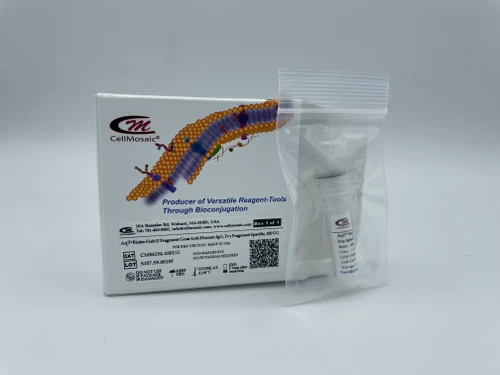
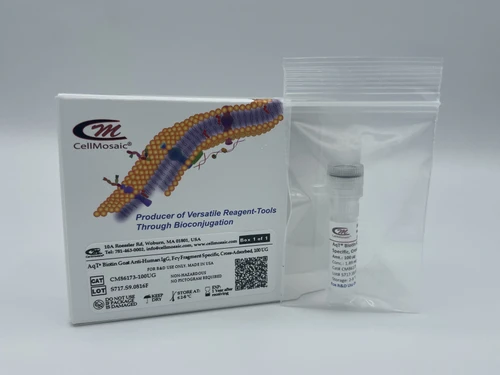
Product Description
AqT® Biotin Fab' Goat Anti-Mouse IgG, Fcγ Fragment Specific, Cross-Adsorbed is a novel biotinylated polyclonal secondary antibody Fab' fragment developed with CellMosaic's proprietary AqueaTether® (AqT®) linker technology, delivering enhanced assay performance.
| Download Documents | |
|---|---|
| Product Sheet | |
| SDS | COA (Lot S713.S9.0820F) |
AqT® Biotin Fab′ Goat Anti-Mouse IgG is a monovalent, biotinylated secondary-antibody fragment specific for the Fcγ region of human IgG. The Fab′ fragment is prepared from a polyclonal goat secondary antibody. The antibody is cross-adsorbed to minimize cross-reactivity with bovine, horse, and human serum proteins.
The product is site-specifically biotinylated through hinge-region thiols using CellMosaic’s proprietary super-hydrophilic AqT® linker. Positioning biotin away from the antigen-binding region helps preserve antibody-binding activity while providing consistent and accessible biotin placement. Because the Fab′ fragment lacks the goat Fc region, it can reduce Fc-receptor-mediated background. Its smaller size, compared with intact IgG or F(ab′)₂, may also reduce steric hindrance and improve access to crowded binding sites.
For more information about AqT® Biotinylated Secondary Antibodies, visit:
https://cellmosaic.com/biotinylated-secondary-antibodies/
This product is sold as 1 tube of 100 µg conjugate. For bulk quantities and custom packaging requirements, please contact us for pricing and availability.
For a detailed description of the AqT® technologies, please see our technology section.
Key Features
- Monovalent binding to reduce secondary-antibody-mediated crosslinking
- Site-specific biotinylation through hinge-region thiols
- Average of 2–3 biotin molecules per Fab’ fragment
- No goat Fc region, helping reduce Fc-receptor-mediated background
- Smaller than intact IgG or F(ab’)2, potentially reducing steric hindrance
- Protein content determined by UV/HPLC analysis.
- Biotin incorporation measured using a biotin assay.
- Cross-adsorbed to minimize cross-reactivity with bovine, horse, and human serum proteins
- Advanced AqT® linker technology: Utilizes CellMosaic’s proprietary, super-hydrophilic, water-soluble, charge-neutral AqT® linker to enhance aqueous solubility and minimize aggregation.
Applications
- Enzyme-linked immunosorbent assays (ELISA)
- Flow Cytometry, Immunohistochemistry (IHC)
- Immunocytochemistry (ICC)
- Western Blotting
- Immunoprecipitation (IP) and Pull-Down Assays
- Biosensor and Surface Immobilization, including SPR and BLI
- Cell Isolation and Magnetic Separation
Specifications
- Physical Appearance: Clear solution in 1xPBS buffer with stabilizers.
- Storage Temp: –20°C or below.
- Purity: ≥90% Fab' conjugates by SEC-HPLC (refer COA of each lot for actual value).
- Amount Biotin Loaded: 2–3 biotin molecules per Fab' fragment (refer COA of each lot for actual value).
Antibody Information
- Target: Mouse IgG
- Immunogen: Mouse IgG Fcγ Fragment
- Specificity: Mouse IgG Fcγ
- Species Reactivity: Mouse
- Cross-Adsorption: Bovine, horse, and human serum proteins
- Host Species: Goat
- Fragment Type: Fab’ Fragment of Goat IgG, prepared by pepsin digestion followed by reduction of F(ab’)2
- Antibody Type: Polyclonal
- Country of Manufacture: USA
Characterization of AqT® Biotin Fab' Fragment Goat Anti-Mouse IgG, Fcγ Specific by HPLC
Lot Number: S713.S9.0820F (Biotin Loading: 2.4 by Biotin Assay)
Figure 1. Representative size-exclusion HPLC profiles of AqT® Biotin Fab' Goat Anti-Mouse IgG, Fcγ fragment specific, cross-adsorbed.
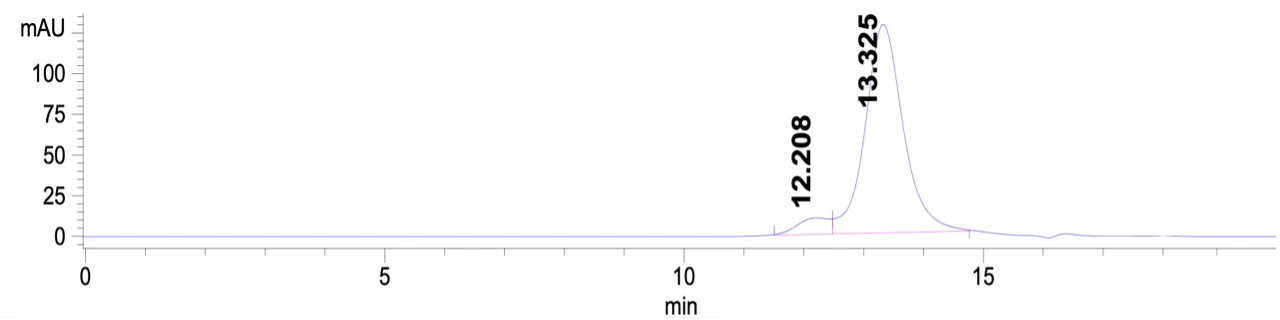
Note: SEC separates the conjugates by apparent MW or size in aqueous solution. In general, higher-MW species elute earlier. SEC is also a useful tool for assessing the level of aggregation in a biopolymer.
Frequently Asked Questions:
If you can’t find the answer you’re looking for or need information on general topics, please visit the main Frequently Asked Questions (FAQs) section.
Other Details
The information in this document is subject to change without notice. CellMosaic® assumes no responsibility for any errors or omissions that may appear in this document. Under no circumstances shall CellMosaic be liable, whether in contract, tort, warranty, or under any statute or on other legal theory, for special, incidental, indirect, punitive, multiple, or consequential damages related to or arising from this document, including but not limited to the use of this product thereof.CellMosaic’s products, including but not limited to AqT®, NeIon™, oxLink™ and sxLink™ (collectively, the “Products”), are covered by, or are the subject of, one or more issued patents and pending patent applications, including without limitation: 9,688,663 B2; 8,907,079 B2; 9,511,150 B2; 9,907,854 B2; 9,346,833 B2; 9,518,067 B2; CN104066451B; CN107043339B; CA 2,841,313; EP 2734238 B1; AU2012284055; JP 6240599 B2; and corresponding foreign patents and patent applications. The purchase of the Product conveys solely a limited, non-exclusive, non-transferable, non-sublicensable license to use the Product only for the purchaser’s internal research and development purposes. No right or license is granted, either expressly or by implication, estoppel, or otherwise, under any patent, trademark, copyright, or other intellectual property right of CellMosaic, except as expressly stated herein. Any commercial use of the Product is strictly prohibited without a separate written agreement from CellMosaic. Prohibited commercial uses include, without limitation: (a) the sale, lease, licensing, distribution, or other transfer of the Product or any materials derived from or produced using the Product; (b) the sale, lease, licensing, or other grant of rights to use the Product or any materials derived from or produced using the Product; and (c) the use of the Product to perform services for a fee or other consideration for third parties, including without limitation contract research, screening services, or diagnostic or therapeutic applications. For information regarding commercial licensing or collaboration, please contact us at info@cellmosaic.com.